Key takeaways
- Cities with the newest housing stock average 2.5 times fewer burglaries than cities dominated by historic homes.
- Frisco, TX, has one of the newest housing stocks and one of the lowest burglary rates (fewer than 6 per 100,000 residents).
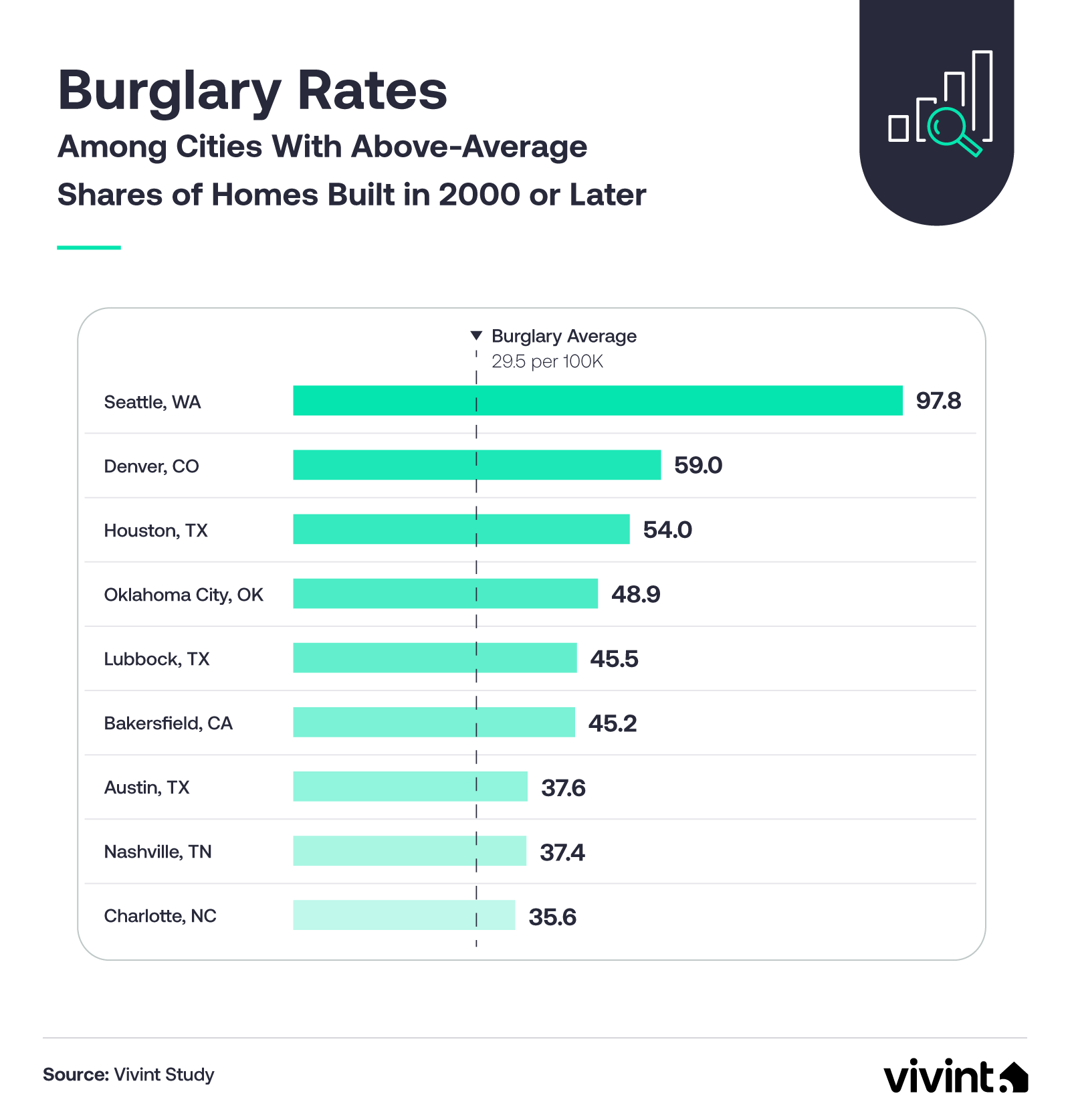
- New construction doesn't guarantee safety: Seattle, Denver, and Houston all have above-average shares of new housing and above-average burglary rates.
- Seattle recorded 97.8 burglaries per 100,000 residents despite 37.5% of homes being newer construction (more than 3x the average).
- Burglary rates climb with home age: 14.8 per 100,000 residents in the newest cities, rising steadily to 36.6 in historic ones.
- Every city where more than half the homes were built after the year 2000 fell below the burglary average.
When shopping for a home, buyers often assume that newer construction means better security, modern deadbolts, reinforced frames, and smart home-ready wiring built right in. This analysis cross-referenced 2024 FBI Uniform Crime Reporting burglary data for 177 of the largest U.S. cities with U.S. Census Bureau American Community Survey data on housing stock age to test that assumption. In some cases, housing age does relate to burglary risk, but construction year alone doesn't tell the whole story of how safe a home actually is.
Newer homes, fewer break-ins, but only to a point
The data shows a clear pattern across U.S. cities: the newer the housing stock, the lower the average burglary rate. But as cities with high shares of new construction and stubbornly high crime rates demonstrate, the age of construction is only part of the equation.
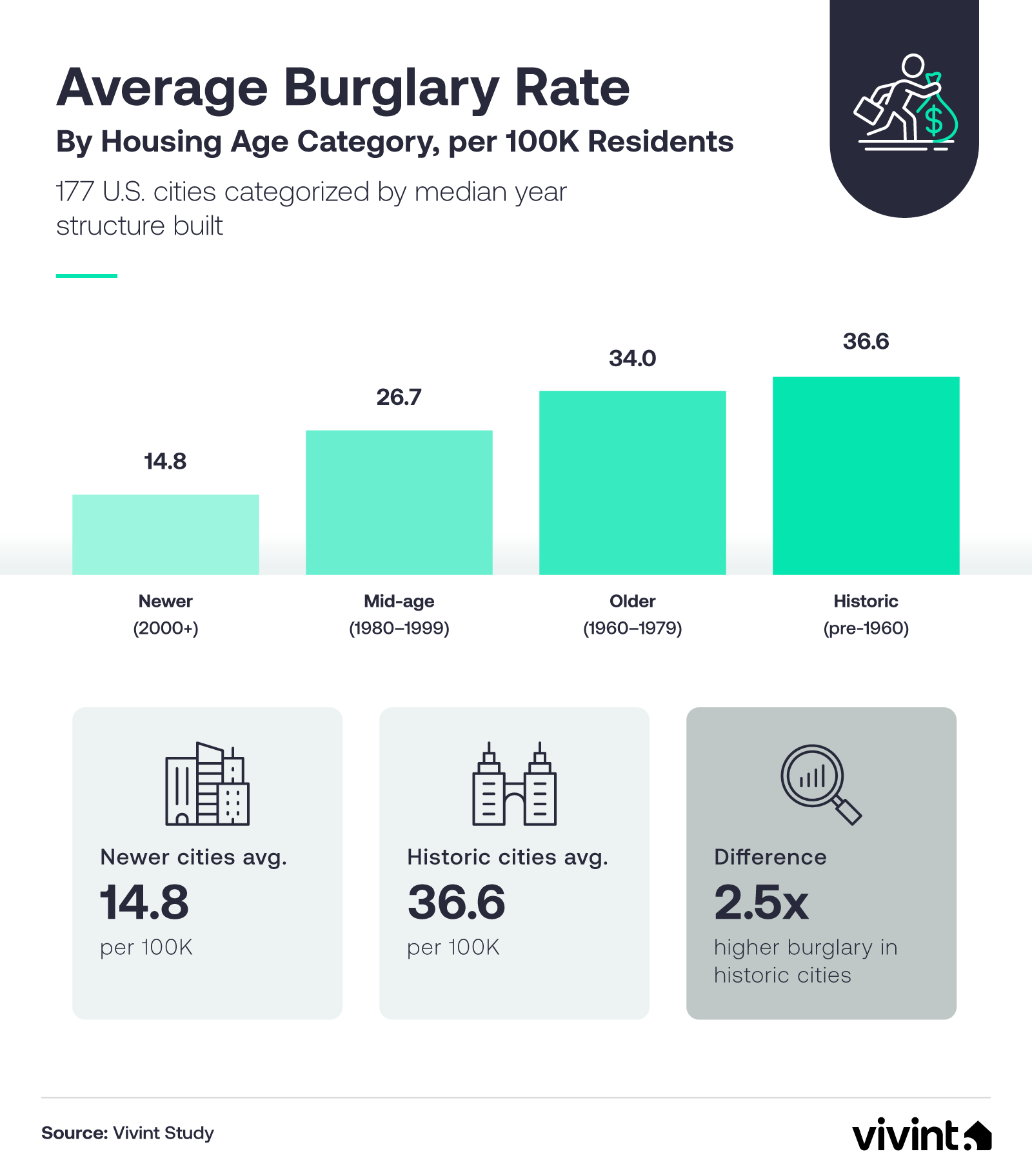
Cities where the median home was built in 2000 or later averaged 14.8 burglaries per 100,000 residents. That's less than half the rate seen in historic cities, where the median home predates 1960, and the average climbed to 36.6 per 100,000 residents.
Burglary rates climbed steadily across all four housing age categories:
- 14.8 in newer cities (with the most new homes built in or after the year 2000)
- 26.7 in mid-age cities (homes built between 1980 and 1999)
- 34.0 in older cities (homes built between 1960 and 1979)
- 36.6 in historic cities (pre-1960 homes)
Historic cities experienced burglary rates 2.5 times higher than their newer counterparts.
See where your city falls
To see how individual cities fit the pattern, we plotted all 177 cities by their share of homes built after 2000 and their average burglary rate, and then split the results into four groups based on the averages, revealing which cities are:
- New and safe
- New but risky
- Old but safe
- Old but risky
Some of the most striking exceptions involve cities that have grown rapidly in recent decades.