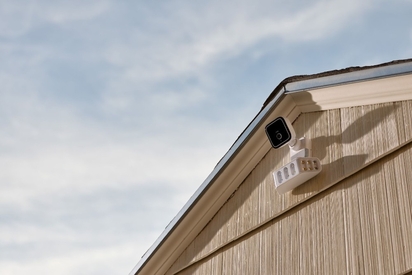
Discover key features to consider when selecting the ideal outdoor security camera, ensuring safety and effectiveness for your needs.
How Does Night Vision Work in Doorbell Cameras?
Quick Answer: Night vision in doorbell cameras works by using infrared (IR) LEDs to emit invisible light that reflects off objects and people. The camera's sensor detects this reflected infrared light and converts it into a visible black-and-white image, allowing you to see clearly in complete darkness.
Key takeaways:
- Night vision doorbell cameras use infrared LEDs to illuminate and capture video in low-light or complete darkness
- IR LEDs emit light at wavelengths (typically 850nm or 940nm) invisible to the human eye but detectable by camera sensors
- The camera sensor converts reflected infrared light into electronic signals, producing black-and-white images
- Most doorbell cameras can detect motion and capture clear footage up to 25–30 feet in total darkness
- Color night vision uses visible spotlights instead of IR
This guide breaks down how night vision technology works, its scientific basis, how Vivint products utilize it, and how it compares to leading competitors. We also explore recent innovations in infrared light, ambient light processing, and image quality enhancement.
How do night vision cameras work?
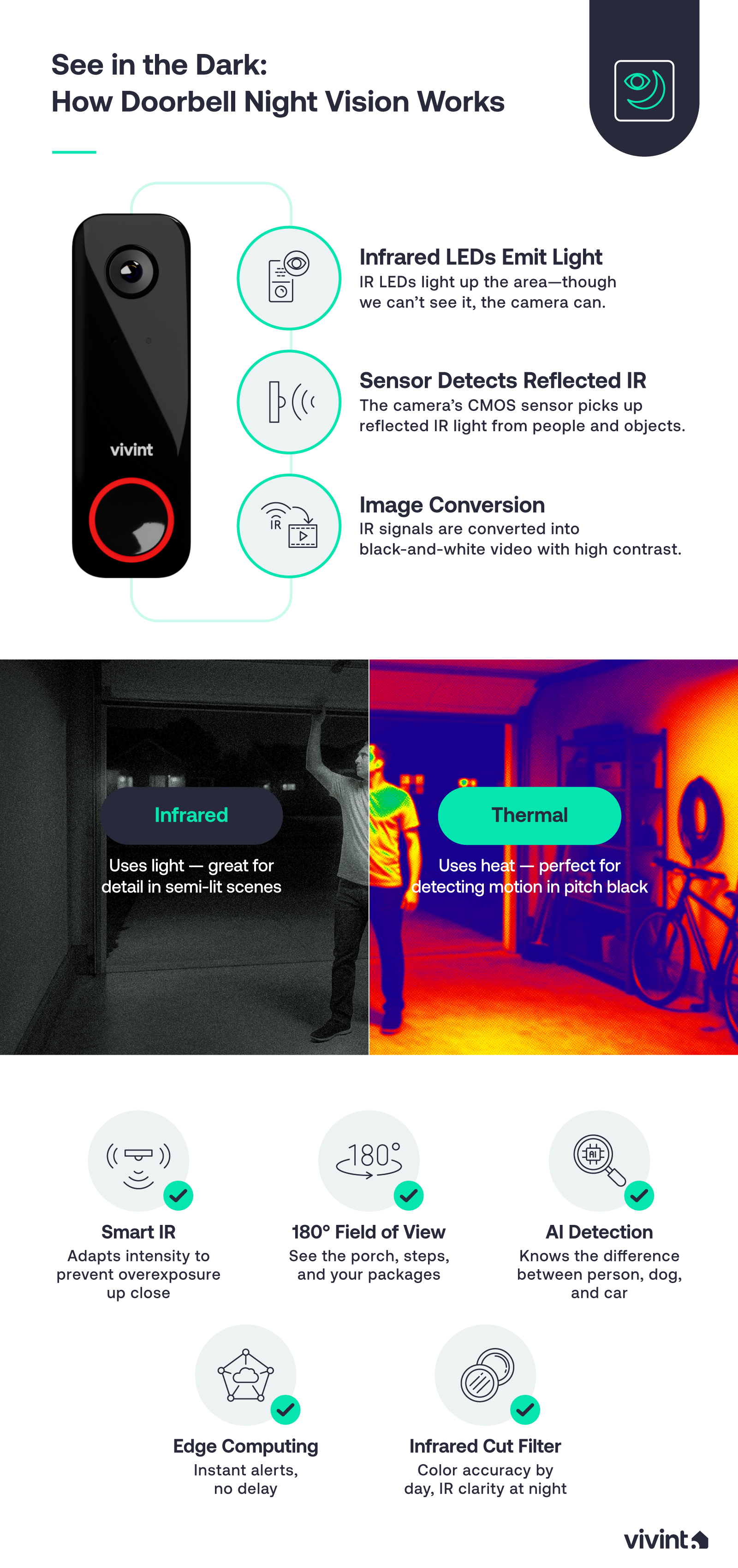
Night vision in doorbell cameras uses infrared LED technology to illuminate and capture video footage in low-light or complete darkness. In low-light conditions, infrared LEDs emit IR light that reflects off objects in the environment. The camera’s sensor then detects this reflection and converts it into electronic signals, producing black-and-white images.
How night vision works: Step-by-step
- IR LEDs emit invisible infrared light. The camera's built-in LEDs emit light at wavelengths (typically 850nm or 940nm) invisible to the human eye
- Light reflects off objects and people in the camera's field of view
- The camera sensor detects the reflected infrared light.
- The signal is converted into a visible image. The sensor transforms the light data into a black-and-white video image
These images are not just grayscale placeholders—they carry high contrast and edge detail that the naked eye would miss in darkness. Infrared cameras use CMOS or CCD sensors to interpret these reflections efficiently, with CMOS now preferred for its power efficiency and integration in smart systems.
Free Bonus Download: Vivint Doorbell Camera Pro Guide
Types of night vision technology
Not all night vision is created equal, and understanding the different types can help you choose the right tech for your specific security needs.
From well-lit porches to pitch-black properties, the way a camera sees in the dark can vary dramatically. Active infrared (IR) systems, the most common in home setups, use built-in IR LEDs to illuminate the scene. Passive systems amplify whatever ambient light is available, while thermal imaging detects heat signatures even in total darkness. Each type comes with its strengths and trade-offs, such as:
- Active IR systems: Rely on IR LEDs and are common in home security.
- Passive systems: Depend on available light and amplify it using intensifier tubes.
- Thermal imaging: Best for detecting heat signatures in total darkness.
Each has its pros and cons depending on whether you’re monitoring a front porch, driveway, or remote cabin.
What is infrared night vision?
Infrared night vision is a technology that uses IR LEDs to emit light at wavelengths invisible to the human eye. The light reflects off of objects and is captured by the camera sensor, producing black-and-white images—even in total darkness.
Infrared night vision vs. color night vision vs thermal imaging
There are three primary types of night vision systems: infrared night vision, color night vision, thermal imaging.
- Infrared night vision: Relies on IR illumination and visible light enhancement. This method captures detailed black-and-white images, even in no-light conditions. Most doorbell cameras use IR LEDs operating at 850nm (faint red glow visible) or 940nm (completely invisible) wavelengths.
- Color night vision: Uses visible spotlights to illuminate the scene, producing full-color footage. Ideal for identifying clothing colors or vehicle details.
- Thermal imaging: Detects heat signatures instead of reflected light. It visualizes temperature differences, producing images based on the heat emitted by objects and people. This feature is particularly helpful for detecting motion in total darkness, fog, or smoke—scenarios common in law enforcement or search and rescue.
Choose infrared for discreet monitoring; choose color night vision when identifying details like clothing or car color is important. Thermal cameras don’t depend on light, making them suitable for use cases where visibility is nonexistent. However, they’re typically more expensive and less detailed for facial recognition or package detection.
Related article
Vivint Doorbell Camera Reviews
What makes Vivint night vision cameras stand out?
The Vivint doorbell camera leverages powerful IR light arrays to extend night vision capabilities beyond the standard range. The Doorbell Camera Pro, for example, uses infrared LEDs to detect motion and deliver black-and-white images in total darkness up to 25 feet.
Here’s what differentiates Vivint from the rest:
- AI-based detection: Vivint doesn’t just record footage—it interprets it. The camera’s sensor can distinguish between people, animals, and vehicles to minimize false alerts.
- IR cut filter for daytime clarity: During daylight, the IR cut filter ensures color images retain their accuracy.
- Local and cloud storage: If Wi-Fi goes down, the camera maintains local recording until a connection is restored.
- Field of view: With a 180° vertical and horizontal field of view, the system minimizes blind spots, even capturing packages placed below the lens.
These features work in tandem to offer homeowners peace of mind, no matter the lighting conditions.
< >
Vivint vs. competitors
Not all doorbell cameras are created equal when it comes to protecting your home day and night. Vivint sets itself apart by focusing on proactive security, not just passive monitoring.
With innovations like Smart Deter AI, professional installation, and robust night vision capabilities, the Vivint Doorbell Camera Pro is designed for homeowners who want more than just footage —they want deterrence.
Let’s see how Vivint compares to other top contenders:
| Feature | Vivint Doorbell Camera Pro | Top Competitor #1 | Top Competitor #2 |
|---|---|---|---|
| Infrared night vision | Yes | Yes | Yes |
| Color night vision | No | Available with subscription | Yes |
| Field of view | 180° | 150° | 160° |
| Image quality | High-res + Smart Deter | 1536p | 1080p HD |
| Installation | Professional only | DIY or pro | Professional only |
| Storage options | Cloud + onboard | Cloud only (with plan) | Cloud + smart integrations |
While competitor #1 offers DIY installation and color night vision, Vivint provides smarter detection and professional-grade durability. Competitor #2 appeals to users who value full security system integration like Vivint offers, but has a smaller field of view and doesn't come with Smart Deter tech.
Related article
How Package Detection Works
The science of image enhancement in low-light conditions
Image enhancement is the process of increasing visual clarity by adjusting contrast, exposure, and edge sharpness. In night vision technology, this often includes:
- Light amplification: Captures available light (from stars, streetlights, or moonlight) and amplifies it using image intensifier tubes.
- Noise reduction algorithms: Filters out graininess common in low-light recordings.
- Dynamic range optimization: Ensures bright spots like headlights or porch lights don’t wash out nearby shadows.
These adjustments allow for clearer footage, even in near pitch-black environments, especially when paired with wide-field-of-view lenses.
Innovations in infrared light and night vision capabilities
In the ever-advancing world of home security, visibility in the dark is no longer a luxury—it’s a necessity. Recent innovations have improved night vision performance significantly:
- Smart IR: Adjusts the intensity of infrared LEDs based on object distance, preventing overexposure when someone is too close.
- Multi-wavelength LEDs: Emit broader IR wavelengths for more consistent coverage and better object detection at edges.
- Edge computing: On-device AI now processes data locally, reducing lag in motion detection and real-time alerts.
Vivint integrates these innovations into its night vision security cameras to support proactive defense rather than reactive response.

Practical takeaways for homeowners
Choosing the right night vision security camera for your home isn’t just about seeing in the dark — it’s about seeing clearly, intelligently, and in the right places.
Here’s how to choose the best night vision security camera for your home:
- Evaluate the field of view: For doorstep monitoring, wide-angle lenses prevent blind spots.
- Check for IR cut filters: They protect color accuracy during the day and enhance IR sensitivity at night.
- Consider light sources: If your porch has ambient light from a street lamp, cameras that blend visible light with IR may give better results.
- Prioritize smart detection: Features like package detection and person alerts save time by filtering noise.
Protect your home with Vivint
Understanding how night vision cameras work can help you make smarter decisions about your home security system. Whether you prioritize image quality in complete darkness or look for real-time alerts via smartphone, the right blend of infrared illumination, sensor technology, and smart features can drastically enhance your peace of mind.
To explore your security options contact us at 855.822.1220 to request a free quote today.
Related article
How Do Doorbell Cameras Work?
FAQs
Learn more about how night vision works in doorbell cameras.
Q: Can night vision cameras record in complete darkness?
Yes. Night vision security cameras use infrared LEDs to capture clear footage, even in total darkness.
Q: Do night vision cameras always show black-and-white images?
No. Standard infrared night vision produces black-and-white images, but some models offer color night bision by using visible spotlights.
Q: What’s the difference between IR night vision and thermal imaging?
IR night vision detects reflected infrared light, while thermal imaging detects heat signatures. Thermal cameras are typically more expensive and less detailed for facial recognition or package detection.
Q: Can I install a Vivint doorbell myself?
Vivint systems require professional installation to ensure proper integration with your home security system.
Get a free quote today.
A Vivint Smart Home Pro will contact you within 24 hours. Or skip the form and call now: 844.481.8630.
Everything works together
Combine products
for a safer home
You may also like:
Security Cameras
How to Choose a Home Security Camera (Complete Decision Guide)
Aug. 04, 2026

Security Cameras
Wireless vs. Wired Home Security Cameras: Which Is Best for You?
Explore the pros and cons of wireless and wired home security cameras to determine the best choice for your safety and convenience.
Jul. 28, 2026
Security Cameras
How Vivint Doorbell Camera Alerts & Cloud Recording Work
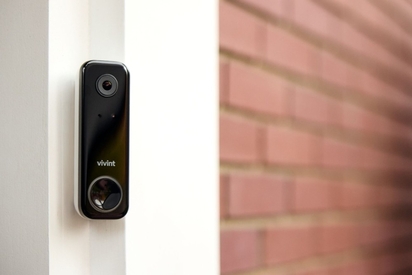
The Vivint Doorbell Camera Pro delivers real-time alerts, AI-powered detection, cloud storage and recording, and Smart Deter™ to help protect your front door and packages.
Jul. 06, 2026
Related Content
-
Outdoor Camera - Security Cameras
Vivint outdoor security cameras make surveillance easy. View your live video feed anywhere from the convenience of your phone. Call 855.742.4173 to learn more.
-
Security Camera Systems
Vivint's Home Security Cameras System allows you to keep an eye on your home via Indoor Security Camera & Outdoor Security Cameras all Accessible through Vivint’s App. Call 855-743-7375 to ...
-
Indoor Security Camera & Indoor Camera Systems
Vivint’s Indoor Camera gives you Sight & Sound with its two way talk & one touch callout. Call 855.724.4415 Today for More Information about our Award Winning 24/7 Home Automation Systems.


